
Paducah Metal Roof Coating Questions
Answers on coating commercial metal roofs in Paducah and nearby towns, from rust and screws to silicone, acrylic, spray foam, and permits by town.
Metal Roof Coating Questions Answered
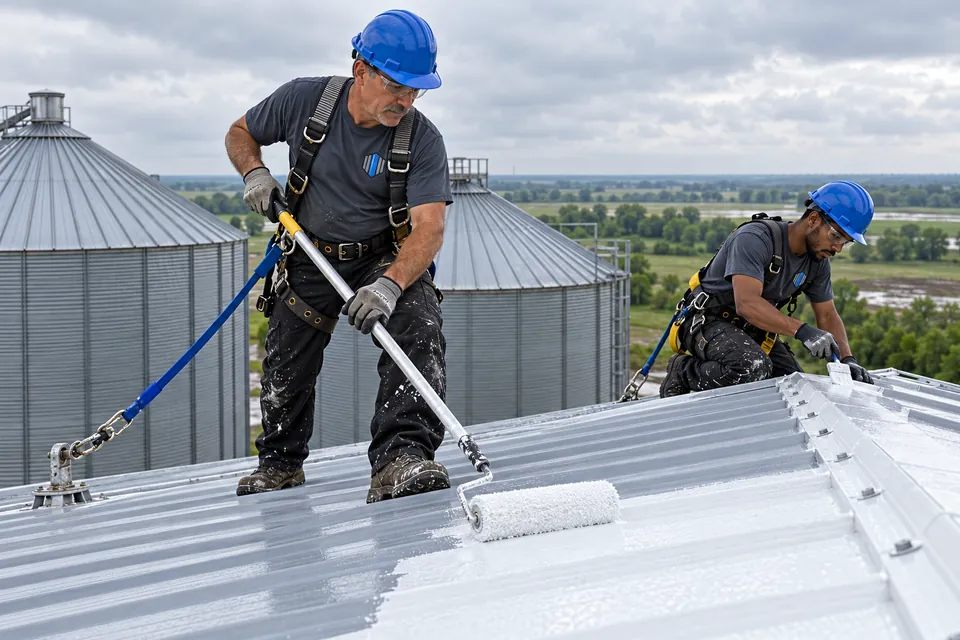
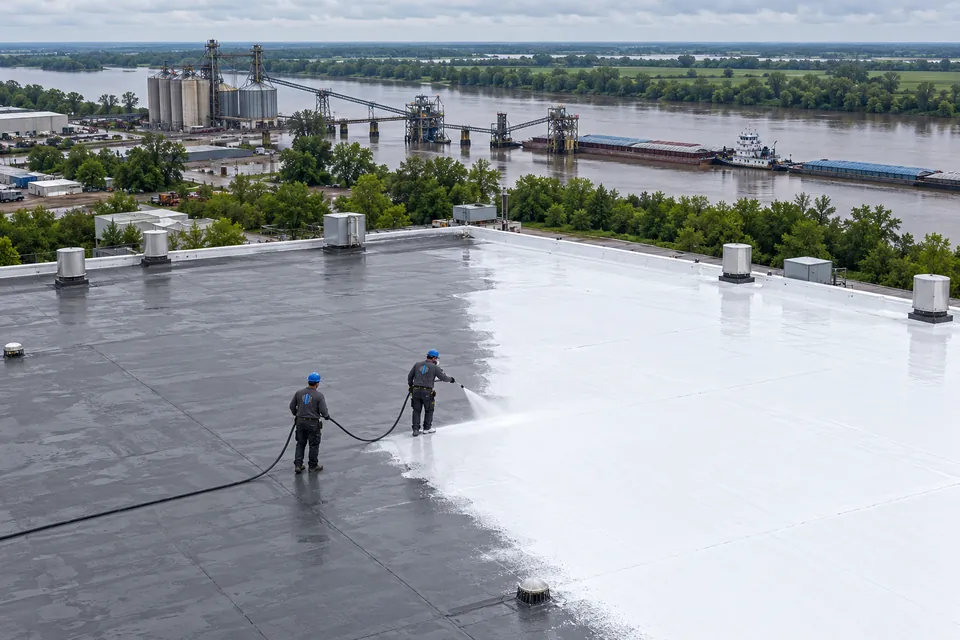
Metal roof coating is a fluid-applied membrane sprayed or rolled over a cleaned, repaired metal roof to seal its seams, fasteners and rust. Paducah Metal Roof Coating coats commercial metal roofs in Paducah, McCracken County, Kentucky, and nearby towns, and also installs silicone, acrylic, spray foam and shingle roof coatings on commercial buildings.
Metal Roof Coating Basics
What is a metal roof coating on a commercial building?
A metal roof coating is a liquid membrane that cures into one continuous rubbery layer over the panels, seams and fasteners of a commercial metal roof. Crews clean the roof, treat rust, seal every fastener and panel lap, then apply a primer where the coating maker calls for one, followed by base and top coats.
The finished film covers the exposed screw heads and washers that leak first on most R-panel roofs. It also bridges side laps and end laps, which move as the steel heats and cools each day.
Coating restores a roof whose panels still hold their shape. Panels rusted through, crushed, or loose at the purlins get replaced before any coating goes on.
Which commercial buildings in the Paducah area are good candidates for coating?
Metal buildings with intact panels, surface rust only, and leaks traced to fasteners or laps are the strongest candidates for coating. Warehouses, shop buildings, retail strips with metal roofs, church fellowship halls, and barns used for business all fit when the steel underneath is still solid.
A roof walk sorts candidates quickly.
- Panels flex underfoot only between purlins, with no soft spots.
- Rust shows as orange bloom on the surface, with no pinholes letting daylight through.
- Gutters and ridge caps are attached and draining.
Buildings with widespread perforation, sagging purlins, or wet insulation trapped under the panels need repair or re-paneling first.
Does a coating stop leaks on an old metal roof?
Coating stops leaks at the places metal roofs usually leak, which are fasteners, side laps, end laps, ridge caps, and flashings around curbs and pipes. The prep and the reinforced seams do most of that work, with the field coat tying them together.
Before the field coat, each leak path gets its own treatment. Loose or stripped screws are replaced with oversized fasteners and new washers. End laps get a seam sealer or fabric-reinforced coating. Skylight panels and HVAC curb flashings get detailed by hand.
Leaks from a hole in a gutter, a cracked skylight panel, or water entering through a wall panel need separate repairs. Tracing each stain inside to its source comes first.
How is coating different from adding a new roof over the old metal?
A retrofit adds a new roof system, such as new panels on sub-framing or spray foam, on top of the old panels, while coating seals the existing metal in place. Coating adds almost no weight and keeps the building's current profile.
| Approach | What goes on the roof | Best fit |
|---|---|---|
| Coating | Fluid membrane over panels, fasteners and laps | Solid panels with surface rust and fastener leaks |
| Spray foam plus coating | Foam layer over the panels, then a protective coat | Roofs needing added insulation or a smoother surface |
| Retrofit panels | New metal on sub-framing over the old roof | Heavy rust or panel damage over intact framing |
Retrofit panels and foam add dead load, so the purlins and frame get checked before either one goes on.
Rust, Fasteners and Seams
Can you coat over rust on a metal roof?
Surface rust can be coated after it is cleaned and treated, while rust that has eaten through the steel needs new metal first. The difference shows when the panel is tapped and probed with a scraper.
| Rust condition | What it looks like | Usual treatment |
|---|---|---|
| Light rust bloom | Orange haze on paint, steel firm | Clean, wire brush, rust-inhibiting primer |
| Scale rust | Flaking layers, firm steel underneath | Scrape or grind, prime, then coat |
| Red rust at laps | Rust bleeding from end laps and fastener holes | Clean, prime, reinforce the lap with fabric |
| Perforation | Pinholes or holes showing daylight | Patch panel or replace the sheet |
Primer choice follows the coating maker's instructions for each rust level, and heavy rust areas get a second look after cleaning, since scale often hides thin spots.
What causes white rust on galvanized roof panels?
White rust is a powdery white corrosion that forms on the zinc layer of galvanized panels when moisture sits on the metal without drying, often along laps, under debris, and near gutters. It looks minor, yet it means the zinc protecting the steel is being used up.
Coating makers treat galvanized and Galvalume steel differently from painted steel. Most call for a specific cleaner and, on bare zinc, a primer made to bond to it. Skipping that step is a common reason coatings peel off galvanized panels.
Around the Ohio and Tennessee river valleys, dew and fog keep laps damp for long stretches, so white rust shows up at the lower ends of panels and where leaves pile at ridge vents.
Do the screws on an exposed-fastener roof need to be replaced before coating?
Every fastener on an exposed-fastener roof gets checked before coating, and the loose, stripped, or rusted ones get replaced or fitted with new washers. Rubber washers on R-panel screws dry out and crack in the sun, and a coating applied over a failed washer leaves a leak path right under it.
Most crews handle fasteners in three passes.
- Tightening screws that have backed out from thermal movement.
- Swapping stripped screws for the next size up.
- Sealing each fastener head with sealant or brush-grade coating before the field coat.
Overtightened screws that dimple the panel get attention too, since water collects in the dent around the washer.
How are panel seams and end laps sealed on a coated metal roof?
Panel side laps and end laps are sealed with a seam sealer or a fabric-reinforced coating strip before the main coat goes on. These overlaps flex as the steel expands in afternoon heat and contracts at night, and an unreinforced film can split along them.
End laps, where one panel overlaps the next down the slope, take the most water. Crews clean out the dirt and old caulk, treat red rust at the lap, then embed polyester fabric in a base coat across the joint.
Ridge caps, rake trims, and eave trims get the same treatment where they meet the panels. On standing seam roofs, the locked seams themselves are rarely covered unless they leak.
Choosing a Coating System
Is silicone or acrylic better for a metal roof in western Kentucky?
Silicone holds up better where water ponds or sits, while acrylic performs well on sloped metal roofs that shed water quickly. Both reflect sunlight in white or light colors.
| Factor | Silicone | Acrylic |
|---|---|---|
| Ponding water | Resists it | Softens under standing water |
| Low-slope areas and gutters | Good fit | Weak fit |
| Dirt pickup | Collects dust over time | Stays cleaner |
| Recoating later | Needs silicone over silicone | Accepts many coating types |
| Weather at application | Tolerates cooler, damper days | Needs warm, dry curing time |
Most pitched R-panel roofs shed water fast enough for acrylic. Silicone fits low-slope metal, roofs with dented panels that hold water, and buildings where future recoats will also be silicone.
When does silicone roof coating make sense over metal?
Low-slope metal roofs, dented panels that trap water, and seams near gutters that stay wet after rain are where silicone roof coating makes the most sense over metal. Silicone tolerates standing water and keeps its stretch after long sun exposure.
The trade-offs are real.
- Dust and pollen stick to silicone, so a white surface turns gray faster.
- Future recoats need silicone or a primer made for it, since most other coatings will not bond to it.
- Sealants and patches used later must be silicone-compatible.
On metal, silicone usually goes over a rust-inhibiting primer, with fabric-reinforced silicone at end laps, ridge caps, and skylight panel edges.
When is acrylic roof coating the right call?
Acrylic roof coating is the right call on sloped metal roofs that drain cleanly, especially where the owner wants a bright white surface that stays cleaner than silicone. Water-based acrylics clean up easily and accept recoats from several coating families.
Acrylic needs warm, dry weather to cure. A heavy dew or a pop-up shower before the film skins over can wash uncured coating off the panels, which makes timing important in humid western Kentucky summers.
Ponding is where acrylic falls short. Flat spots at gutters, hail-dented panels, and low areas around curbs need silicone spot treatment or a different system before an acrylic field coat.
Can spray foam roofing go over a metal roof?
Spray foam roofing can go over a metal roof after the panels are cleaned, fasteners secured, and the purlins checked for the added load. The foam fills the corrugations, adds insulation, and forms a continuous surface that then gets a protective coating.
| Factor | Spray foam over metal | Coating only |
|---|---|---|
| Insulation added | Yes, by foam thickness | Very little |
| Fastener heads and laps | Buried under foam | Sealed one by one |
| Weight added | Light, still needs a structural check | Negligible |
| Roof profile | Flat, smooth surface | Ribs stay visible |
| Upkeep | Recoat the foam's top coat over time | Recoat the film over time |
Spray foam fits metal buildings that run hot or cold inside, such as shops and warehouses with little insulation. Its top coat needs regular attention, since sunlight breaks down exposed foam.
Can an asphalt shingle roof on a commercial building be coated?
Some asphalt shingle roofs on commercial buildings can be coated, but only when the shingles are still flat, holding granules, and approved for coating by the shingle maker or coating maker. Coating a shingle roof that is curling, cracked, or shedding granules into the gutters seals in the damage.
Shingle roof coating shows up most on strip centers, office buildings, and churches with steep shingle sections. Owners weigh a few trade-offs.
- Manufacturer approval comes first, since some shingle makers exclude coatings.
- Ventilation through ridge vents and soffits has to stay open.
- Appearance changes, because the coating fills the texture between shingle tabs.
On a mixed building, the metal roof over the warehouse and the shingled office front can each get the system that fits.
Weather in Paducah and the Purchase Area
How does western Kentucky weather affect a coated metal roof?
Western Kentucky's hot, humid summers, freeze-and-thaw winters, and strong spring and fall storms all stress metal roofs at the same points, which are fasteners, laps, and flashings. Steel panels expand on summer afternoons and shrink overnight, working screws loose and opening end laps.
A coating helps in a few ways.
- Light colors reflect sunlight, so the panels run cooler and move less.
- Elastomeric films stretch with the steel instead of cracking.
- Sealed laps keep wind-driven rain from being pushed uphill under the panels.
The National Weather Service office in Paducah issues forecasts and warnings for this region, and its forecasts drive coating schedules, since every coating needs dry hours to cure.
Can hail-dented metal panels be coated?
Hail-dented metal panels can be coated when the dents are cosmetic and the paint, fasteners, and laps are still intact. Dents become a concern when they hold water, crack the factory finish, or crush a rib near a fastener.
Each hail-hit roof gets a close look at a few details.
- Cracked paint at a dent shows where rust will start.
- Crushed ribs at side laps can open the seam.
- Dented skylight panels and ridge caps break more often than the steel.
Ponding in dents points toward silicone. If an insurance claim is open, the adjuster should see the roof before any coating covers the damage.
When is the best time of year to coat a metal roof near Paducah?
Late spring through early fall gives the longest stretches of warm, dry weather for coating a metal roof near Paducah. Each product lists a minimum surface temperature and a dry window before rain or dew, and the coating maker's data sheet sets those limits.
| Season | What helps | What to watch |
|---|---|---|
| Spring | Mild panel temperatures | Storm lines and wet weeks |
| Summer | Fast cure, long days | Panels too hot by afternoon, humidity |
| Fall | Steady weather, cooler steel | Short days and heavy morning dew |
| Winter | Planning and repairs | Cold steel under cure limits |
Silicone handles cooler, damper conditions better than acrylic, which widens the season at both ends.
Question About Your Own Roof?
Call and describe the panels, the leaks, and the town, and we will answer for your building.
Prep, Application and Downtime
How is a metal roof prepared for coating?
Preparation of a metal roof for coating starts with cleaning, then rust treatment, fastener work, and seam reinforcement, in that order. Coating sticks only as well as the surface under it, so prep takes most of the labor on most jobs.
| Step | Standing seam roof | Exposed-fastener R-panel roof |
|---|---|---|
| Cleaning | Power wash, remove chalking | Power wash, remove chalking and oil |
| Rust | Spot treat at clips and trims | Treat laps, fastener holes, panel ends |
| Fasteners | Few exposed, mostly at trims | Check, tighten, or replace every screw |
| Seams | Inspect locked seams, seal if leaking | Reinforce end laps and side laps |
| Details | Penetrations, curbs, ridge caps | Penetrations, curbs, ridge caps, skylights |
A wipe test on the old paint shows chalking, and a chalky film left in place weakens adhesion.
How long does it take to coat a commercial metal roof?
Coating time on a commercial metal roof comes down to roof size, the amount of rust and fastener work, and the weather. A small shop roof and a large warehouse sit at very different ends of the schedule.
Work moves in stages.
- Washing and drying the panels.
- Rust treatment and primer, then fastener and seam details.
- Base and top coats, each with its own cure time.
Rain days stretch the schedule, since coatings need dry panels and dry hours after application. Crews can work in sections so finished areas stay sealed while the next section is prepped.
Can a business stay open while the roof is being coated?
Most businesses stay open during a metal roof coating, since the work happens on top of the roof with no tear-off and no openings into the building. Crews plan around loading docks, parking, and rooftop units.
A few details deserve planning ahead.
- Rooftop air intakes can pull in coating odor, so some units are shut off or covered during application.
- Overspray control matters near parked cars and neighboring buildings, which is why crews roll or use shields on windy days.
- Ladder or lift access needs a spot away from customer entrances.
Interior leaks often stop once fasteners and laps are sealed, before the final coat goes on.
Cost, Value and Taxes
What affects the cost of coating a metal roof?
The cost of coating a metal roof comes from roof size, how much rust and fastener work the panels need, the coating chemistry, and how hard the roof is to reach. Prep labor is often the largest driver.
Cost drivers show up on the roof itself.
- Rust level at end laps, panel ends, and gutters.
- Fastener count, and how many are stripped or missing washers.
- Number of curbs, skylight panels, vents, and pipe penetrations.
- Slope and height, which decide whether lifts or extra fall protection come into play.
- Coating thickness and fabric reinforcement called for by the coating maker.
Spray foam and re-paneling add their own material and labor on top of these.
Should a metal roof be coated, re-paneled, or replaced?
A metal roof should be coated when the panels are solid and leaks come from fasteners and laps, re-paneled when sections are rusted through, and replaced when the framing or most of the panels have failed.
| Option | Panel condition | Main work |
|---|---|---|
| Coat | Firm, surface rust, leaking fasteners | Clean, treat, seal, coat |
| Restore | Mixed, some rusted sheets | Replace bad sheets, then coat |
| Re-panel | Widespread perforation, framing intact | New panels on existing purlins |
| Replace | Damaged framing or insulation | New roof system and deck repairs |
Insulation is part of the call too. Wet insulation under the panels holds water against the steel and points toward re-paneling or replacement, while dry insulation can stay in place under a coating.
Does a commercial roof coating qualify for Section 179?
Roof improvements on existing nonresidential buildings can qualify for Section 179 expensing under federal tax rules. IRS Publication 946 lists the 2026 limit as $2,560,000, with the deduction phasing out above $4,090,000 of qualifying property placed in service.
Some limits apply.
- Residential rental property is excluded.
- Eligibility turns on whether the work counts as a capital improvement or a routine repair.
- State tax treatment can differ from federal rules.
A CPA should review the invoices and the scope of work, from fastener replacement and seam sealing to a full coating, before any deduction is claimed.
Permits, Codes and Utilities
Do you need a permit to coat a commercial metal roof in Kentucky?
Permit rules for a commercial roof coating vary by jurisdiction, so the city or county building office should confirm before work starts. Kentucky splits building code responsibility between state and local inspection under the Kentucky Building Code.
| Town | County | Building contact listed |
|---|---|---|
| Paducah | McCracken | City Community Development, Building Division |
| Outside Paducah city limits | McCracken | McCracken County Inspection Department |
| Mayfield | Graves | City of Mayfield local building inspector |
| Murray | Calloway | City of Murray building contact |
| Benton, Calvert City | Marshall | Confirm with the city hall and Marshall County |
| Eddyville | Lyon | Lyon County local building inspector |
| Reidland | McCracken (unincorporated) | McCracken County Inspection Department |
| Kevil | Ballard (confirm at the McCracken line) | Ballard County building inspector on the state contact sheet |
| La Center | Ballard | Ballard County building inspector; electrical through the County Judge/Executive or city office |
| Wickliffe | Ballard | Ballard County state and local building inspector |
| Gilbertsville | Marshall | Marshall County Building Office (confirm coverage) |
| Hardin | Marshall | Marshall County Building Office |
| Grand Rivers | Livingston | Kentucky Department of Housing, Buildings and Construction |
| Smithland | Livingston | Kentucky Department of Housing, Buildings and Construction; state plumbing inspector for drain piping |
| Kuttawa | Lyon | Lyon County local building inspector |
| Fredonia | Caldwell | State building inspector for Caldwell County |
Jobs that include structural changes, re-paneling, or added spray foam draw more permit attention than a straight recoat over existing fasteners and laps.
How do utilities and energy programs relate to a coated metal roof?
A reflective coating lowers the heat a metal roof absorbs, which can reduce cooling load in an air-conditioned building, and the local electric utility is the place to ask about any current commercial efficiency programs. Programs change, so none should be assumed.
Two details help when asking.
- Rated products appear in the with tested reflectance and emittance values.
- Rooftop units and ductwork stay accessible after coating, so utility or HVAC staff can still service them.
Electric service across McCracken, Graves, Calloway, Marshall, Lyon, Livingston, Ballard, and Caldwell counties comes from several providers, so the answer changes with the building's address.
Questions by Town
Does Paducah require a permit for a commercial roof coating project?
Paducah's Community Development Department, Building Division, at City Hall issues construction permits inside city limits, and its guidance says new construction, additions, and renovations need a permit apart from cosmetic finishes. Whether a recoat counts as a finish or a renovation is the Building Division's call.
Projects that replace panels, add spray foam, or change rooftop curbs and skylight openings lean toward renovation. A plain recoat over existing panels sits closer to a finish. Asking before scheduling keeps a job from stopping midway.
Buildings outside city limits in McCracken County go through the county's inspection department instead.
What should owners near Paducah's riverfront and floodwall check on a metal roof?
Owners of metal buildings near Paducah's Ohio River floodwall should check the low points of the roof where river fog and humidity keep panels damp, especially end laps, gutters, and panel ends at the eaves. Those spots show white rust and red rust first.
Some buildings near the riverfront pair metal additions with older masonry walls. The joint where a metal roof meets a parapet or brick wall needs its counterflashing checked before coating.
The floodwall holds back the river; roof drainage is its own system. Gutters, downspouts, and scuppers on these buildings should run clear so roof water leaves fast during heavy storms.
How did the 2021 tornado change metal roofs in Mayfield?
The December 10 and 11, 2021 tornado, documented by the National Weather Service in Paducah, tore through Mayfield in Graves County. Rebuilding since then has left a mix of new panels and older steel on the same blocks, sometimes on the same building.
Coating a repaired roof means checking where new metal meets old.
- End laps between replacement sheets and original panels can mismatch in profile.
- Fastener patterns from storm repairs are sometimes uneven or doubled.
- Ridge caps and trims replaced in a hurry deserve a close look for missing closures.
Newer panels with an intact factory finish may need only fastener and lap work before coating.
Who handles building inspections for roof work in Mayfield?
Mayfield building inspections for roof work inside city limits start with the city, since the Graves County contact sheet from the Kentucky Department of Housing, Buildings and Construction lists a local building inspector for the City of Mayfield, separate from the one listed for Graves County.
That split matters for metal buildings at the edges of town, where a shop or barn just outside the limits falls under the county listing. Checking the parcel's jurisdiction first keeps the right office involved.
Structural work, such as new purlins under storm-damaged panels or added spray foam, draws the most review. A recoat over intact panels and fasteners is a shorter conversation.
Which office covers roof coating permits in Murray?
Murray sits in Calloway County, and the state contact sheet for Calloway County lists a City of Murray building contact alongside a Calloway County local building inspector and a state building inspector. Jobs inside city limits begin with the city, while county properties start with the county inspector.
Commercial buildings on the edges of Murray can fall either way, so the parcel address decides it. Sorting this out early matters most when the job includes replacing rusted panels, adding spray foam, or cutting new curb openings for rooftop units.
For a plain recoat over existing fasteners and seams, the call is short and still worth making.
What roof issues show up on farm and shop buildings around Murray?
Farm and shop buildings around Murray in Calloway County often carry exposed-fastener metal roofs over uninsulated interiors, where condensation rusts the panels from the underside. A top coating seals the outer surface and leaves that underside rust untouched.
Before coating, crews look up from inside as well as down from the roof.
- Drips from the underside of panels on cool mornings point to condensation rather than leaks.
- Rust along purlin lines can mean the steel is thinning from both sides.
- Bird and wasp nests at open ridge caps often hide damaged closures.
Spray foam over the metal, or insulation added inside, addresses condensation in a way a top coating alone leaves unsolved.
What should Benton building owners know about permits in Marshall County?
Benton is the Marshall County seat, so owners in town check with the City of Benton and with Marshall County about which office reviews commercial roof work. The Kentucky Department of Housing, Buildings and Construction also keeps county contact sheets for state inspection.
Jurisdiction can differ between a building on a Benton city street and one on a county road a mile out. That answer shapes the paperwork for a re-paneling or spray foam job.
Recoating alone, with fastener replacement and seam sealing, is the lightest form of the work and the simplest to clear with either office.
How does Kentucky Lake affect metal roofs on commercial buildings near Benton?
Commercial buildings around Benton sit near Kentucky Lake, and lake humidity, fog, and morning dew keep metal panels wet longer than on drier sites. Longer wet time speeds white rust on galvanized panels and red rust at end laps.
That moisture also shortens the dry window for coating. Acrylic needs the dew to burn off and enough dry hours before evening, so crews start later in the morning and stop earlier in the afternoon. Silicone gives more room on damp days.
Buildings that sit closed for weeks between seasons let leaks at skylight panels and ridge caps go unnoticed until stored goods are damaged.
What should owners of industrial buildings in Calvert City check before coating?
Industrial and warehouse roofs in Calvert City, along the Tennessee River in Marshall County, may collect residue from process exhaust and stacks that blocks coating adhesion. A wash that removes only dirt leaves that film behind.
After cleaning, crews test adhesion on a small patch before committing to a system. Roof areas near exhaust fans, vents, and process equipment curbs often need extra cleaning or a specific primer.
Chemical exposure also shapes coating choice. Coating makers publish resistance data, and that data should match whatever settles on the roof. Plant rules on hot work and spark-producing tools also govern fastener removal and grinding.
Can a metal roof in Calvert City be coated while a plant keeps running?
Metal roofs on Calvert City industrial buildings can be coated while operations continue inside, because coating adds a layer on top of the panels with no openings cut into the roof. Planning centers on rooftop equipment and air intakes.
| Item | Planning step |
|---|---|
| Air intakes and makeup air units | Schedule shutdown or cover during spraying |
| Exhaust fans and stacks | Mark keep-out zones and wind direction limits |
| Skylight panels | Mark and protect against foot traffic |
| Gutters and drains | Keep clear so wash water and rain leave fast |
Plant safety programs set access rules, roof entry permits, and fall protection requirements that the coating crew follows.
Who handles building inspections for roof coating work in Eddyville?
Eddyville is the Lyon County seat, and the state contact sheet for Lyon County lists a county local building inspector and a state building inspector, with no separate city listing for Eddyville. Roof work questions in town start with the Lyon County contact.
That county-level setup differs from Paducah, Mayfield, and Murray, where the city keeps its own building contact. Confirming the office early matters most for jobs that add spray foam, replace panels, or reframe around skylight openings.
Any change to roof drainage, such as new gutters or scuppers, belongs in that same conversation.
What roof problems do wooded lots around Eddyville cause on metal buildings?
Wooded lots around Eddyville and Lake Barkley drop leaves, needles, and branches onto metal roofs, and that debris holds moisture against the panels. Wet debris in gutters, behind curbs, and against ridge caps leads to white rust, pinholes, and clogged downspouts.
Tree cover adds a few prep steps before coating.
- Mildew and moss come off with a cleaner rated for the coating system.
- Branch strikes leave dents and punctures that need patch panels.
- Overhanging limbs get trimmed so debris and abrasion stop.
Gutter guards or wider downspouts help keep the coated roof draining in fall.
Which office handles roof coating permits for commercial buildings in Reidland?
Reidland is an unincorporated community in McCracken County, so commercial roof work there goes through the McCracken County Inspection Department instead of Paducah's Building Division. A Paducah mailing address on a Reidland building can send owners to City Hall first, yet the parcel's location outside city limits is what decides the office.
Bring photos of the fasteners, end laps, and rooftop unit curbs to that first call. Swapping rusted panels or adding spray foam draws more county review than a coat over intact steel.
Is a commercial roof in Kevil reviewed by Ballard County or McCracken County?
Kevil is a Ballard County city near the McCracken County line, and the county a building sits in decides which inspector reviews its roof work. Ballard County relies on the inspector named on its state contact sheet, while McCracken County runs its own inspection department.
Check the parcel record before scheduling anything beyond a recoat, such as replacing rusted R-panels, rebuilding ridge caps, or cutting new curb openings. A shop on a county road outside Kevil can belong to either county, and the right office keeps the job from stalling partway.
What should La Center owners know about rooftop electrical work during a coating job?
La Center owners should know that the Ballard County contact sheet sends local electrical inspection to the County Judge/Executive's office or to the city office where the work happens. That comes up when rooftop units, disconnects, or conduit runs get moved so crews can coat beneath them.
Most recoats leave wiring alone. Crews mask conduit straps and coat around disconnect boxes and unit curbs. Once a curb gets rebuilt or a unit is lifted and reset, the electrical side becomes its own inspection with the city or county office.
Who reviews commercial roof work in Wickliffe?
Commercial roof work in Wickliffe, the Ballard County seat, goes to the inspector the Ballard County contact sheet lists as both the state and the local building inspector. One person holding both roles keeps the permit question in one place.
Wickliffe sits where the Ohio River meets the Mississippi, and river fog keeps metal panels damp into late morning. Damp starts slow acrylic curing and feed red rust at panel ends and gutter hangers. Silicone handles those mornings better, which often settles the system choice for buildings on low ground near the rivers.
Does the Marshall County Building Office cover roof coating near Gilbertsville?
The Marshall County Building Office states that building permits are required for all construction in Marshall County, commercial and residential, so a coating job near Gilbertsville starts with that office. Its page names Benton, Calvert City, Hardin, and the unincorporated county as its coverage, and Gilbertsville is absent from that list.
Ask the office to confirm the parcel before work begins. Buildings close to Kentucky Dam and the lake shoreline take open-water wind, so loose rake trim, lifted ridge caps, and backed-out fasteners along the eaves get fixed before the first coat.
Do roof coating jobs in Hardin need a Marshall County permit?
Hardin is one of the cities the Marshall County Building Office names as covered, so that county office answers whether a recoat needs a permit there. The office enforces the Kentucky Building Code and reviews plans for commercial work.
That conversation goes faster with specifics in hand: the panel profile, how many fasteners show failed washers, and whether any skylight panels or end laps get replaced. Re-paneling sections or adding spray foam belongs in the first call, since those change the roof assembly and its surface alike.
Where do Grand Rivers owners go for a commercial roofing permit?
Grand Rivers owners start with the Kentucky Department of Housing, Buildings and Construction, because the Livingston County contact sheet names no local building inspector and directs commercial construction to the state department.
The town sits on the strip of land between Kentucky Lake and Lake Barkley, where shoreline wind and humidity wear on exposed metal. Before coating, check skylight panels for cracked edges, pipe boots for split rubber, and fasteners along the windward eave. Bring that list to the state inspector if any panels get replaced.
Who reviews roof drain work on a commercial building in Smithland?
Questions about the building side of a roof job in Smithland, at the mouth of the Cumberland River, go to the state Department of Housing, Buildings and Construction, and drain piping inside the building raises a second question for the state plumbing inspector. The Livingston County contact sheet places that inspector's office hours at the county health department in Smithland.
Low-slope metal roofs with interior drains show trouble as ponding rings around the drain bowl and rust at the clamping ring. Coating around a drain stays roof work. Cutting out the drain body or the leader under it is where the plumbing question starts.
What should Kuttawa owners check on a metal roof near Lake Barkley?
Kuttawa owners should check the lake-facing eaves first, where wind off Lake Barkley lifts trim and loosens fasteners at the panel ends. Kuttawa has no line of its own on the Lyon County contact sheet, so the county's local building inspector fields roof questions for the town.
Before coating, walk the gutter line and the rake trim, reset loose closures under the ridge cap, and replace stripped screws with oversized fasteners. Lake humidity also leaves white rust on galvanized flashing, which gets cleaned and primed before the coating goes down.
Who inspects commercial roof work in Fredonia?
Fredonia building owners deal with the state for roof work, because the Caldwell County contact sheet lists a state building inspector and no local building inspector. That puts commercial reviews in Fredonia with the Kentucky Department of Housing, Buildings and Construction.
Fredonia is the only Caldwell County town in the Paducah service area. For a recoat, gather photos of the fasteners, panel laps, and any rust bloom at the eaves. For a job that replaces panels or adds foam insulation, add the panel gauge and profile, which help the state inspector judge whether the job alters the roof assembly.
Getting Started
What happens during a metal roof inspection before coating?
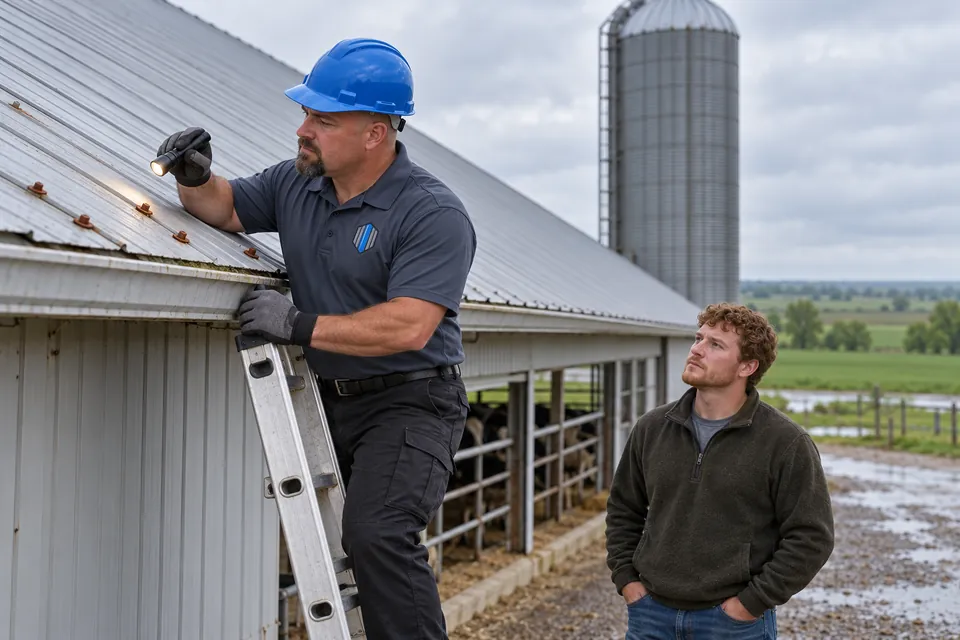
A roof inspection before coating checks every part of the metal roof that will carry the new film, from panel condition to fasteners, laps, flashings, and drainage. The inspector walks the roof, probes rust, and checks inside for stains and condensation.
Common findings get recorded with photos.
- Fastener counts and the share with failed washers.
- Rust levels at end laps, panel ends, and gutters.
- Condition of skylight panels, curbs, and pipe boots.
- Ponding spots, dents, and soft insulation.
The visit ends with a clear call on coat, restore, re-panel, or replace, plus the coating system that fits. Paducah Metal Roof Coating starts every metal roof job with this inspection.
What information helps when requesting roof coating service for a commercial building?
Roof size, roof type, panel age, and the places leaks show inside are the facts that speed up the first conversation about a commercial roof coating. Photos of the roof surface and of ceiling stains help too.
Useful details to gather ahead of time.
- Roof type, such as exposed-fastener R-panel, standing seam, shingle, or a mix.
- Leak locations matched to roof features like skylight panels, curbs, or end laps.
- Access, including the roof hatch, ladder points, and lift space.
- History of past coatings, patches, or sealant at fasteners.
- Insurance claims tied to hail or wind.
Owners who track stains after each storm make the source of each leak easier to find.
Sources
Sources for these answers
- City of Paducah, Permits for Construction
- McCracken County Inspection Department
- Kentucky Department of Housing, Buildings and Construction, Graves County contact sheet
- Kentucky Department of Housing, Buildings and Construction, Calloway County contact sheet
- Kentucky Department of Housing, Buildings and Construction, Lyon County contact sheet
- National Weather Service Paducah, December 10th and 11th 2021 Tornado
- IRS Publication 946, How To Depreciate Property
- Cool Roof Rating Council, Rated Roof Products Directory
- Marshall County Building Office
- Kentucky Department of Housing, Buildings and Construction, Marshall County contact sheet
- Kentucky Department of Housing, Buildings and Construction, Livingston County contact sheet
- Kentucky Department of Housing, Buildings and Construction, Ballard County contact sheet
- Kentucky Department of Housing, Buildings and Construction, Caldwell County contact sheet
Ready For A Roof Walk?
Bring your questions to the roof walk, and we will answer them with your own panels, screws, and laps in front of us.
Or call (270) 236-5587