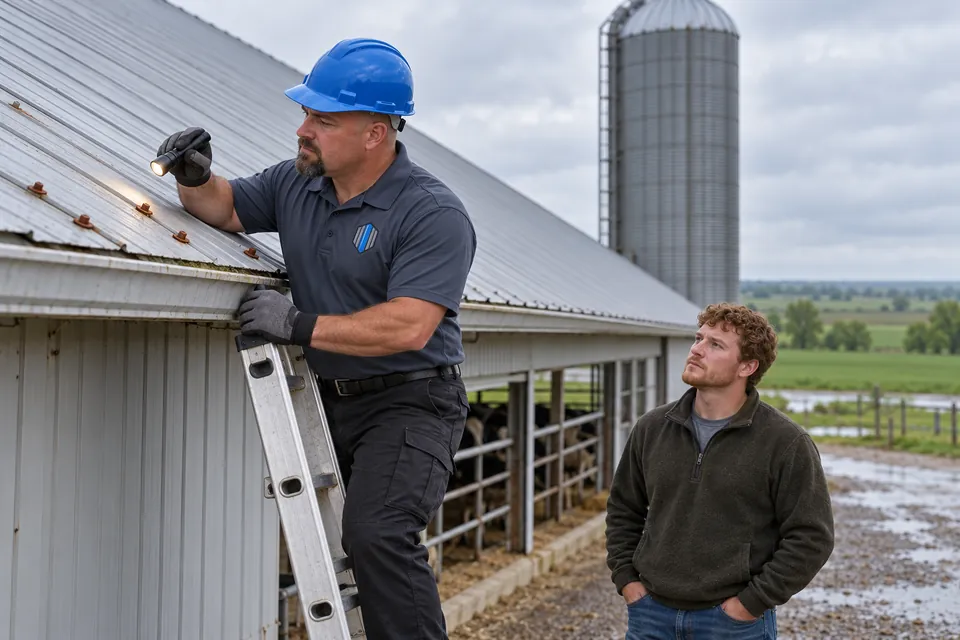
Roofer inspecting fasteners and panel laps on a commercial metal roof
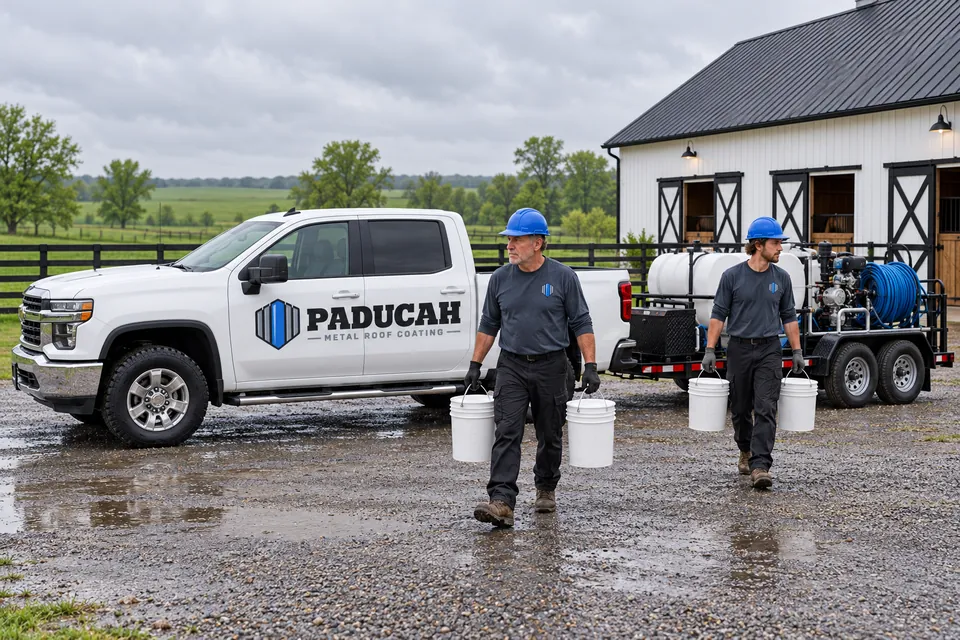
Roof coating work truck parked beside a commercial building

Paducah Metal Roof Coating

We handle metal roof coating for Paducah warehouses, shops, and plants, starting with a roof walk that checks every screw, lap, and gutter before any coating goes on.

Quick Facts

  • Roof walk before any coating
  • Every fastener checked and sealed
  • Five coating systems offered
  • Most businesses stay open throughout
Roof Warning Signs

Signs Your Metal Roof Needs Attention

Most metal roof leaks start at a handful of parts. Here is what to look for from the ground, the roof hatch, and the ceiling below.

  • Watch keep an eye on it
  • Repair First fix before coating
  • Call Now active water
  • Orange Bloom At End Laps

    Rust bleeding from the overlap where one panel meets the next means water sits in the lap. Caught early, the lap is cleaned, primed, and sealed with fabric.

    Repair First
  • Backed-Out Screws

    Heads standing above the rib, or washers cracked flat, are the first leak path on most R-panel roofs. Each one gets tightened, upsized, or resealed.

    Repair First
  • Drips After Every Rain

    Water on the floor after each storm means an open path through a fastener, lap, or flashing right now. Call before stored goods or ceiling tile soak through.

    Call Now
  • Lifted Ridge Caps

    Caps that have pulled loose let wind push rain under the top edge of the panels. Loose closures and nests at the ridge are worth a look on the next roof walk.

    Watch
  • Gutters That Overflow

    Clogged or sagging gutters back water up to the panel ends at the eave, where red rust starts. Clearing and resetting them comes before any coating.

    Repair First
  • White Powder On Galvanized Laps

    That chalky film is white rust using up the zinc layer, often where dew sits along laps. It needs a specific cleaner and a zinc primer before coating.

    Watch
What We Coat

Metal Roof Coating And Four More Systems

Each system goes on a commercial roof in a set order. The rail on every card shows that order, so you know what happens on your roof and when.

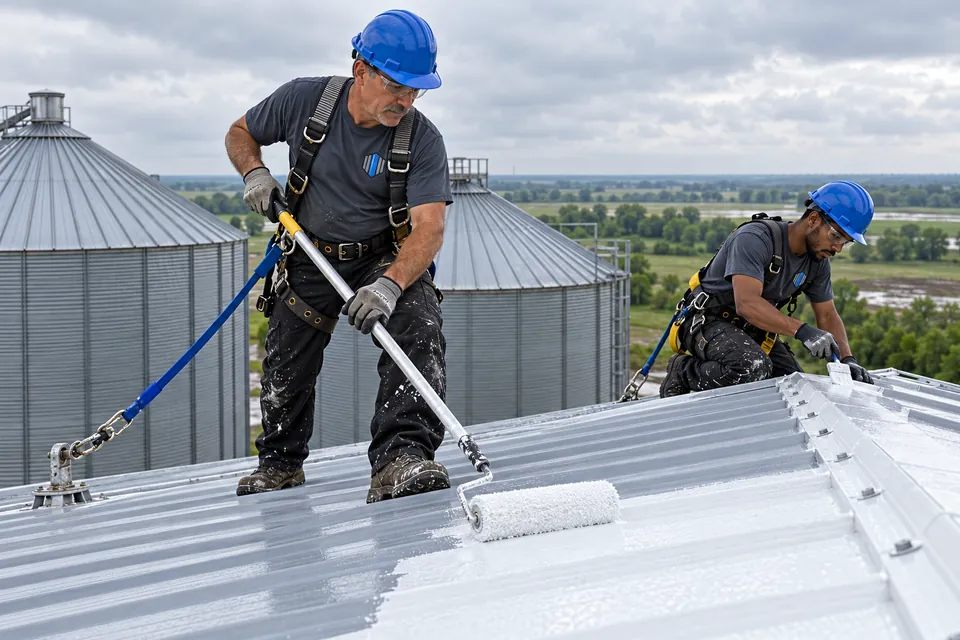
Roofing crew rolling coating over the panels of a commercial metal roof

Metal Roof Coating

Exposed-fastener R-panel and standing seam roofs with surface rust and leaking screws. The panels stay in place while every fastener and lap is sealed, then the whole field is coated.

Order Of Work
  1. 1Wash Panels
  2. 2Treat Rust
  3. 3Seal Laps
  4. 4Topcoat
Metal Roof Coating in Paducah
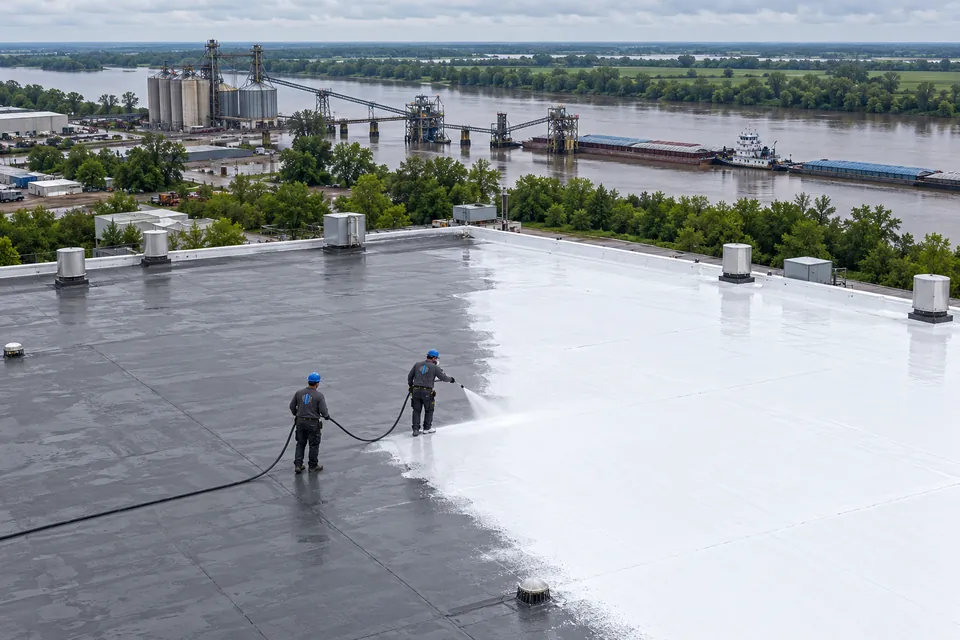
Aerial view of a low-slope commercial roof with a white silicone coating

Silicone Roof Coating

Low-slope metal, dented panels that hold water, and gutter lines that stay wet after rain. Silicone takes standing water and keeps its stretch through long summers in the sun.

Order Of Work
  1. 1Clean
  2. 2Prime
  3. 3Reinforce Seams
  4. 4Silicone Coat
Silicone Roof Coating in Paducah
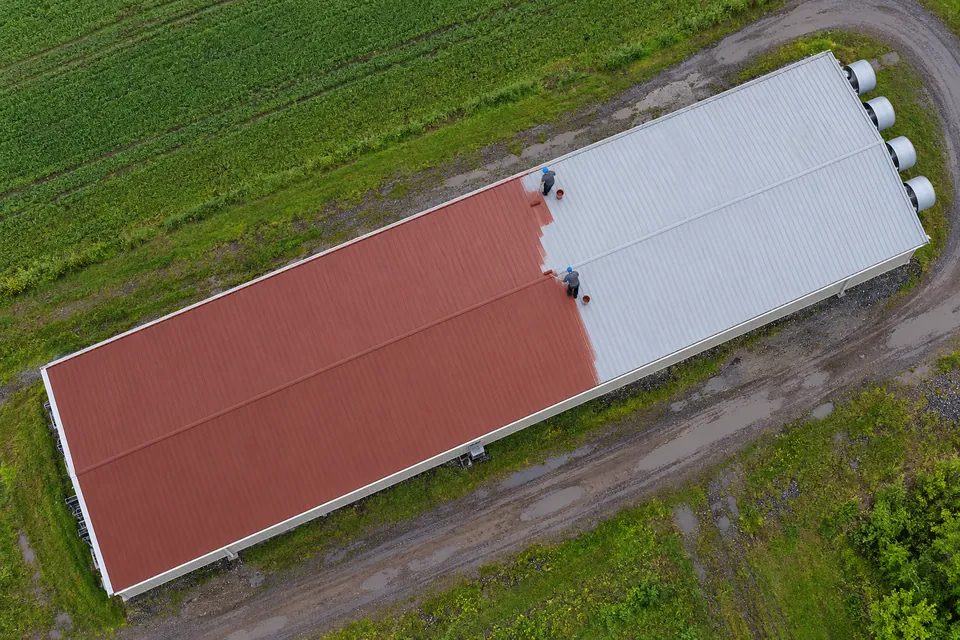
Aerial view of a pitched metal roof on a large shop and barn building

Acrylic Roof Coating

Pitched metal on shops, barns used for business, and warehouses that shed water fast. Acrylic stays bright white, cleans up easily, and accepts recoats from several coating families.

Order Of Work
  1. 1Wash
  2. 2Prime Rust
  3. 3Base Coat
  4. 4Top Coat
Acrylic Roof Coating in Paducah
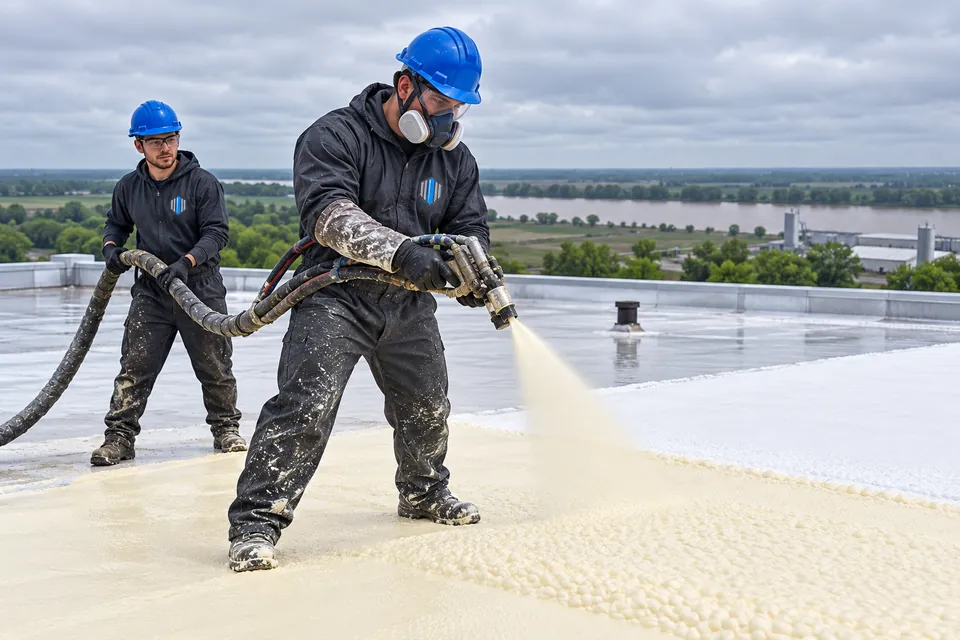
Crew spraying foam insulation across a commercial roof

Spray Foam Roofing

Metal buildings that run hot in summer or sweat in winter with little insulation. Foam fills the corrugations, buries the screw heads, and gets a protective top coat.

Order Of Work
  1. 1Secure Panels
  2. 2Spray Foam
  3. 3Top Coat
Spray Foam Roofing in Paducah
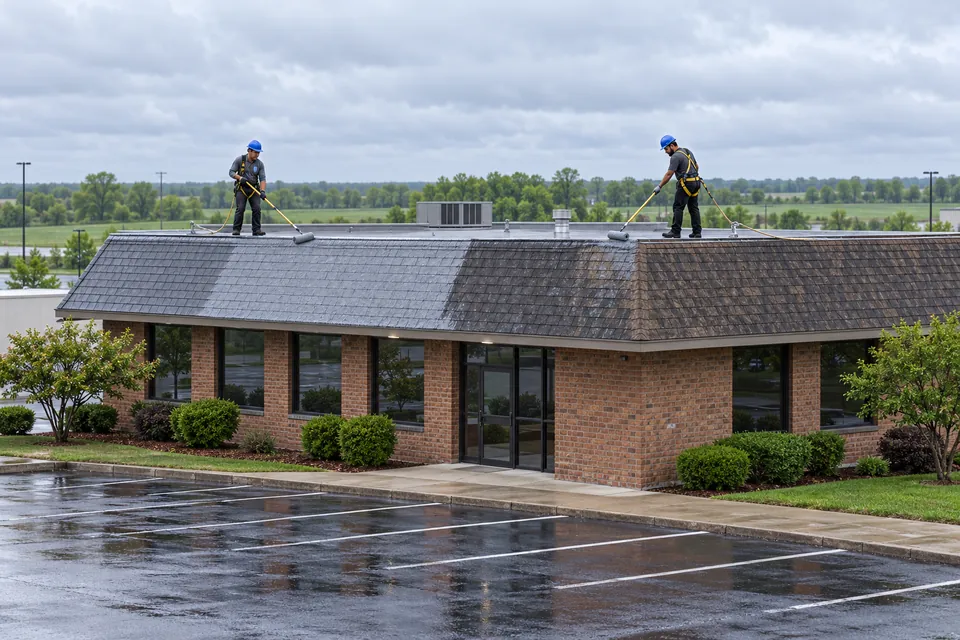
Crew working on a steep shingle section of a commercial building

Shingle Roof Coating

Flat, granule-holding shingle sections on strip centers, offices, and churches, where the shingle maker allows coating. Curling or cracked shingles call for replacement instead.

Order Of Work
  1. 1Approval Check
  2. 2Clean
  3. 3Repair
  4. 4Coat
Shingle Roof Coating in Paducah
Next Step

Water Coming Through Your Metal Roof?

Call and tell us where the stain or drip shows inside, and whether it follows rain or cool mornings. That detail separates a leak from condensation.

How The Work Runs

From Roof Walk To Final Coat

Five steps in the order they happen on a coated metal roof. Most of the labor goes into the first three.

  1. 01

    Inspect Your Roof

    Every panel, lap, and fastener gets walked and probed, failed washers are counted, and gutters, curbs, and skylight panels are checked. Inside, we look for ceiling stains and condensation, then photograph the findings.

    On The Roof
  2. 02

    Clean The Panels

    Power washing strips dirt, oil, and the chalky film on old paint, which would weaken adhesion. A wipe test afterward shows whether the chalking is gone.

    On The Roof
  3. 03

    Fix Rust, Screws, And Laps

    Rusted areas are scraped and primed to the coating maker’s spec. Stripped screws give way to oversized fasteners with new washers, and end laps get polyester fabric set in a base coat.

    On The Roof
  4. 04

    Detail Curbs And Penetrations

    Skylight panel edges, pipe boots, HVAC curbs, and ridge caps get hand-applied coating or sealant. These spots move differently from the field, so each one is treated on its own.

    At The Building
  5. 05

    Coat The Field

    Base and top coats go on by roller or sprayer at the thickness the coating maker lists, each with its own cure time. Sections can be finished one at a time.

    On The Roof
Coat Or Replace

Can Your Metal Roof Be Coated?

Match what you see on your roof to the job that usually follows. The roof walk confirms it.

  • Usually Fits
  • Sometimes
  • Rarely
What You See On The RoofCoatRestoreRe-PanelReplace
Firm panels with orange surface rust and leaking screwsUsually FitsSometimesRarelyRarely
A few sheets rusted through, the rest firm underfootSometimesUsually FitsSometimesRarely
Pinholes and daylight across whole sections, framing intactRarelySometimesUsually FitsSometimes
Sagging purlins or wet, crushed insulation under the steelRarelyRarelySometimesUsually Fits
Hail dents that hold water, factory paint still intactUsually FitsSometimesRarelyRarely
Standing seam roof with one leaking seam lineUsually FitsSometimesRarelyRarely
Why Coat

What A Coating Does For A Metal Roof

Four reasons owners coat solid metal roofs instead of tearing them off.

  • Sealed Fasteners

    Each screw head and washer ends up under the film, closing the most common leak path on R-panel roofs.

  • Cooler Panels

    Light-colored coatings reflect sunlight, so the steel runs cooler and moves less between afternoon and night.

  • Less Tear-Off

    Firm panels stay on the building, so the old metal never becomes a load headed to the landfill.

  • Open For Business

    Work stays on top of the roof with no openings cut, so most tenants and staff keep working below.

Service Area

Towns We Cover From Paducah

We coat commercial metal roofs in Paducah and the 15 western Kentucky towns in this table.

Outside these towns? Call us or send us a message.

TownCountyWhat We See On Roofs There
Paducah Home BaseMcCrackenWarehouses, shops, and riverfront buildings where river fog keeps end laps, gutters, and eave panel ends damp.
MayfieldGravesStorm-era repairs where replacement sheets meet older panels, with doubled screw rows and mismatched end laps.
MurrayCallowayUninsulated farm and shop buildings where condensation rusts the panels from the underside along purlin lines.
BentonMarshallKentucky Lake humidity that keeps panels wet longer and feeds white rust at galvanized laps.
Calvert CityMarshallPlant and warehouse roofs carrying exhaust residue that has to come off before a coating will bond.
EddyvilleLyonWooded lots that drop leaves and limbs into gutters, behind curbs, and against ridge caps.
GilbertsvilleMarshallOpen-water wind near Kentucky Dam that lifts ridge caps and loosens rake trim on exposed buildings.
HardinMarshallShops where the scope sets the paperwork: a plain recoat versus replaced skylight panels, end laps, or added foam.
KuttawaLyonLake-facing eaves off Lake Barkley with loose trim, open closures, and white rust on galvanized flashing.
Grand RiversLivingstonShoreline buildings between the two lakes with cracked skylight panel edges and split pipe boots.
SmithlandLivingstonLow-slope metal with interior drains, ponding rings at the drain bowl, and rust at the clamping ring.
KevilBallardR-panel shops on county roads near the McCracken line with worn ridge caps and rusted sheets.
ReidlandMcCrackenCommercial buildings with Paducah mailing addresses, rooftop unit curbs, and county-run inspections.
La CenterBallardConduit straps screwed through the panels and disconnect boxes on the roof field that need masking.
WickliffeBallardLow ground at the river confluence where fog lingers and red rust starts at panel ends and gutter hangers.
FredoniaCaldwellOlder metal buildings where replacement sheets must match the panel gauge and profile, plus rust bloom at the eaves.
Common Questions

Common Paducah Metal Roof Coating Questions

Short answers to what owners ask before a metal roof is coated.

What is a metal roof coating on a commercial building?

It is a liquid membrane that cures into one rubbery layer over the panels, seams, and screws. Before it goes on, the roof is cleaned, rust is treated, and every fastener and lap is sealed, then primer, base, and top coats follow. Panels rusted through or loose at the purlins get replaced first.

How does western Kentucky weather affect a coated metal roof?

Summer heat, freeze-and-thaw winters, and spring and fall storms all work on the same spots: screws, laps, and flashings. A light-colored coating keeps the steel cooler so it moves less, and the elastic film stretches with the panels. Forecasts from the National Weather Service in Paducah set the schedule, since every coating needs dry hours to cure.

Should a metal roof be coated, re-paneled, or replaced?

Coat it when the panels are firm and the leaks come from screws and laps. Re-panel when whole sections are rusted through but the purlins hold, and replace when the framing or most of the panels have failed. Wet insulation under the steel pushes the call toward re-paneling, since it holds water against the metal.

Can standing seam and R-panel roofs both be coated?

Yes. Exposed-fastener R-panel roofs need the most prep, since every screw and washer is checked and sealed. Standing seam roofs have few exposed fasteners, so the work centers on trims, clips, penetrations, and any seam line that leaks. Both get the same wash, rust treatment, and field coat.

Can one building get two different coating systems?

It can. A warehouse with a pitched metal roof and a flat section over the office often gets acrylic on the slopes and silicone where water sits. Low spots on an otherwise sloped roof can take silicone spot treatment before an acrylic field coat, as long as the products are listed as compatible.

What happens to gutters and downspouts during a coating job?

Gutters are cleared before washing, and loose hangers are reset so water leaves the roof fast. Rusted gutter seams get the same rust treatment as the panels, and wash debris is kept out of the downspouts so they drain freely while the coating cures.

Ready When You Are

Get A Free Estimate For Your Metal Roof

Tell us the roof size and what you see inside, and we will set up a roof walk in Paducah or a nearby town.

Or call (270) 236-5587

Call Us (270) 236-5587